
Albert Yong was born like any other child, but his early years were soon overshadowed by tragedy, isolation, and abuse fueled by misunderstanding. At just eight years old, Albert lost his mother and was subsequently accused of bewitching her, leading to her death.
This accusation turned Albert into an outcast, feared by everyone around him, including family members who were supposed to protect him. The grief he felt for his mother was quickly replaced by suspicion, and his entire childhood became filled with neglect, isolation, and stigma. His relatives believed his mother’s death was unnatural, claiming that he was responsible due to witchcraft that he supposedly inherited from his grandmother.
The situation worsened when Albert fell ill himself. Instead of receiving care, his family interpreted his illness as proof of dark influence, subjecting him to beatings, starvation, and punishing rituals intended to rid him of supposed witchcraft. He was neglected and punished, not based on any evidence, but solely on perception.
A Path to Care
Eventually, the news of Albert’s ordeal spread rapidly, capturing the attention of Partners In Health Liberia (PIHL) and the government. In October 2018, PIH’s social protection team collaborated with officials from Liberia’s Ministries of Justice and Gender, Children, and Social Protection to intervene swiftly. They took Albert and connected him to health care services at the PIH-supported James Jenkins Dossen (JJD) Hospital in Harper, where he was diagnosed with severe malnutrition, with his body covered with bruises. Albert immediately began his much-needed, life-saving treatment, coupled with compassionate care and nutritional support through the PIH and Maryland County Health Team social support programs.
Albert’s condition didn’t require treatment alone; it required family support. But everyone, including his elder sister, Elizabeth Ireland, was skeptical of harboring or getting close to Albert because of the witchcraft allegation against him. “I was scared. People said he killed our mother, and he’s a witch,” Elizabeth said.
Following several counseling sessions with Elizabeth, she realized that her brother’s condition was medical and not spiritual; her perception changed.
“When I learned that Albert was just sick and malnourished, not possessed (not a witchcraft), I saw him differently,” Elizabeth said.
With her fears replaced by understanding, she made the courageous decision to welcome her brother into her home in Harper.
In Liberia, there are usually two primary causes of death: medical and superstitious. A superstitious cause of death does not stem from medical or factual reasons but rather from the belief that certain events or actions can predict or lead to death. Sometimes, even when a medical cause is established, some relatives or communities may still associate a person’s death with a supernatural explanation.
Healing Hearts and Rebuilding Lives
With PIH support, Elizabeth received a mini-business start-up support to help the family. To empower Elizabeth and provide stability for Albert, PIH gave her ten bags of coal to launch a small business, and the investment was transformative. “Now I can take full responsibility,” she shared proudly.

Elizabeth Ireland, Albert’s older sister, inspects her coal bags, a business she runs to support herself and pay for Albert’s school fees. Albert was only 8 years old when his mother died, and he was accused of bewitching and murdering her. After enduring neglect and abandonment, he was eventually taken in by Elizabeth, where he began to receive support from Partners in Health (PIH). Photo by Ansumana O. Sesay /PIH
“I even save weekly from my coal profits to pay his school fees.”
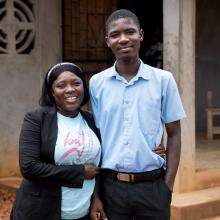
Once frail and rejected, Albert is now a healthy and joyful 5th-grade student. He helps with chores, excels in school, and is finally embraced by his new community. A smiling, confident young boy has replaced the previously shy and withdrawn child. “He eats well, smiles more, and is coming back to himself,” Elizabeth said.
Albert’s journey is not just a powerful story of resilience, but also a reminder of how stigma can be effectively overcome with truth, compassionate care, and love. Exorcisms did not save his life — but a correct diagnosis, consistent medical treatment, and the unwavering support of a family equipped to provide a safe and loving home did.
Reflecting on the transformation, Elizabeth’s voice fills with emotion. “Seeing my brother healthy and happy now makes me ashamed of how I once saw him,” she said. “Only God can repay PIH and the hospital staff for what they’ve done.”
Fortunately, through the compassionate and comprehensive care model of Partners In Health Liberia (PIH-L) and its counterparts working with the County Health Team in rural Maryland County, Albert received the treatment he desperately needed. Today, he is no longer a victim but a thriving student who has overcome stigma and reclaimed his dignity.