
In Maryland County, where access to nutritious food remains a challenge for many families and patients, Partners In Health (PIH) Liberia has taken a bold step to close the gap. Partners In Health Liberia has launched an eight-acre pilot agriculture project designed to provide fresh vegetables and fruits to patients at James Jenkins Dossen (JJD) Memorial Hospital, as part of an effort to address patient nutrition gaps and the significant burden of NCDs. This initiative is part of PIH’s comprehensive strategy to strengthen the county’s health system and improve health outcomes.
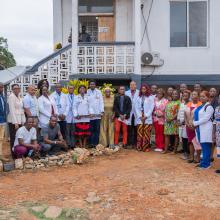
The project was recently inaugurated by Mrs. Wingdie Didi Bertrand Farmer, the wife of the late Dr. Paul Farmer, co-founder and Board Member of Partners In Health, during her visit to Liberia and Maryland County.
Named the Polo Farm Project in honor of Dr. Paul Farmer, this initiative seeks to strengthen patient care by improving access to fresh, nutritious food; reducing PIH’s vegetable procurement costs from Côte d’Ivoire; integrating nutrition as a core component of health system strengthening; advancing PIH’s food as medicine, strategy; and creating employment and skills-building opportunities for local farmers, laborers and the community we serve.

A community member tends to tomatoes on Polo Farm. Picture by Luther N. Mafalleh / PIH
In the few months since its inception, a total of 93 people have worked on the farm in various capacities, with 56% of them being women. “PIH starting a farm on this land is a fine thing because our people don’t have any plantation here in Cavalla District like (as) they do in Pleebo. So, this farm is an opportunity for them to earn something from work,” said Charles H. Gaddeh, Agriculture Technician at Polo Farm.
The Agriculture Technician collaborates closely with local farmers to enhance their skills.
“Our people practice traditional methods of farming. But I am here to help them learn how to carry out new agricultural practices,” Charles said, watching the day’s work unfold.
These innovative practices will ensure the farm’s sustainability for years to come.

A local agriculture technician harvests cucumbers on Polo Farm. Picture by Luther N. Mafalleh / PIH
Given Liberia’s heavy reliance on costly imported foods, this project carries particular importance. It will contribute to long-term food security, generate income for local families, and promote the expansion of local agricultural practices in Maryland County.
In doing so, the project also aims to improve nutrition and reduce the burden of metabolic diseases, including heart disease, type two diabetes, and malnutrition, among patients and the broader community. The farm will cultivate high-demand vegetables and fruits, including cabbage, peppers, tomatoes, collard greens, cucumbers, okra, scarlet eggplant (also known as bitter balls), lettuce, pineapple, bananas, citrus (oranges and limes), soursop, papaya, and avocado.
During a recent harvest, community caretaker Alex H. Dennis couldn’t hide his excitement as he watched the abundance of vegetables being gathered. For Alex, the farm represents more than just a source of food; it’s a classroom. “I am happy that this farm is in my area,” he shared.
“I’m happy to see new ways of planting for the first time. I had never seen plants on a nursery before; I only knew the traditional way.”

A community member at work on Polo Farm. Picture by Luther N. Mafalleh / PIH
Jacob Ziama, the Deputy Director of Operations at PIH, stated that the project also aims to strengthen our academic collaboration with William V.S. Tubman University by providing students with opportunities for applied research and training in sustainable agriculture.
Partners In Health (PIH) integrates the provision of fruits and vegetables into patient care as a form of social support, recognizing that access to nutritious food is a crucial determinant of health outcomes and recovery from illness. This approach goes beyond medical treatment by addressing the root causes of disease, including food insecurity.