Across Liberia and Sierra Leone, substance abuse paints a stark picture, stretching from the corners of impoverished neighborhoods to the comfort of family homes. Historically viewed as a sign of failure or moral weakness, addiction is now being recognized as a serious health issue requiring compassion and care. Through a growing partnership between Partners In Health (PIH), the Ministries of Health in Liberia and Sierra Leone, and local communities, a new model of community-based substance use care is helping transform how addiction is understood and treated.
In Maryland County, Liberia, Partners In Health (PIH) Liberia and the Maryland County Health Team have spent nearly a decade leading a pivotal transformation in the understanding and treatment of substance abuse. Today, that experience is helping inform efforts to strengthen substance use services beyond Liberia’s borders.
Since 2017, PIH Liberia and the County Health Team have been relentless in redesigning mental health care by strengthening community-based mental health services and expanding access to care for some of the country’s most vulnerable populations. By supporting a transition from institutionalization to community-based care, including community outreach, peer support groups, treatment pathways, workforce development, and policy engagement, their work has made a substantial impact, witnessing a remarkable 42.9% increase in follow-up care, reaching 22,481 beneficiaries. This growth is expected to continue, with annual figures rising from 6,290 in 2023 to 8,991 by 2025.
PIH Liberia’s model of compassionate community-based care has reshaped how patients approach help. “Patients rarely walk into health facilities to seek help; instead, they take advantage of the ongoing outreach strategy,” Willis Archie Yansine, PIH mental health program coordinator, shared, highlighting community engagement and peer support groups as keys to success in this transformative journey.
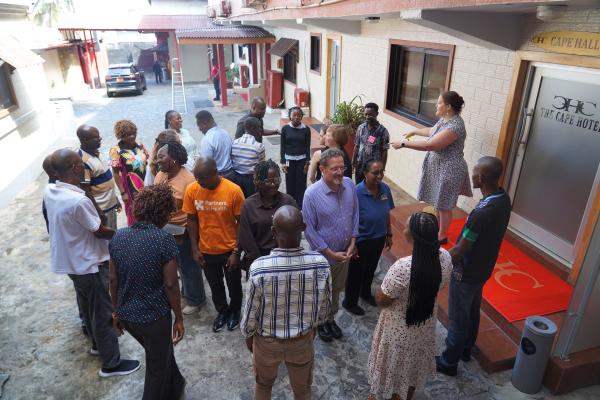
This philosophy was reinforced during a recent cross-country learning exchange between PIH and Ministry of Health mental health teams in Liberia and Sierra Leone. Participants explored strategies for addressing substance use disorders through community-based care, workforce development, policy reform, and patient-centered treatment approaches. During the learning exchange, PIH Liberia’s model was positioned as a blueprint for scaling efforts in Sierra Leone, particularly in places such as Freetown and Koidu, where PIH operates.
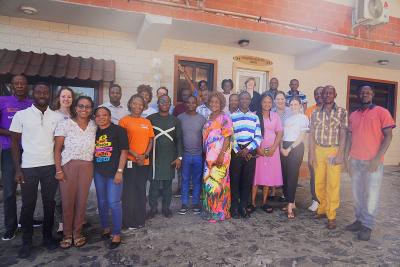
During the first cross-site mental health and substance use workshop held in Monrovia from April 28th to 30th, 2026, team members from Sierra Leone, Boston, and Liberia participated in sessions together. This three-day workshop was specifically designed for mental health professionals, healthcare providers, and community health workers to promote collaboration and develop a comprehensive Partners In Health (PIH) substance use program. Photo by Aminata K. Massaley /PIH.
It symbolizes the co-creation of a comprehensive framework for substance use management between Liberia and Sierra Leone, two nations scarred by civil wars yet united in their pursuit of health equity. The PIH Sierra Leone team is committed to ensuring that their approach not only addresses mental health conditions but also fosters a collaborative environment in which every patient is treated with the dignity and empathy they deserve.
Dr. Stephanie Smith, Co-Director of PIH’s Mental Health Program, emphasized the importance of reframing addiction from a criminal behavior to a chronic medical issue. She stated, “If we can shift from the idea that it’s delinquents to it’s a chronic medical problem, I think that will help a lot, because that’s what it is.” This perspective is vital in bridging the widening gap between policy design and practical care, emphasizing empathic, rights-based treatment that empowers patients in their recovery journey.
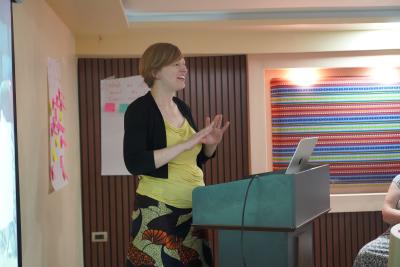
Dr. Stephanie Smith, Co-Director of the PIH Mental Health Program, delivered welcome remarks during a session at the inaugural cross-site mental health and substance use workshop in Monrovia. Photo by Aminata K. Massaley /PIH.
The need for these approaches is significant. More than 400,000 individuals in Liberia grapple with mental health challenges, including approximately 130,000 experiencing severe conditions such as depression and addiction. The crisis is compounded by a shortage of trained mental health professionals, rendering community-based solutions essential. Poverty, unemployment, trauma, and social exclusion often intersect with substance use disorders, making community-centered responses particularly important to tackling the national drug crisis.
The urgency of this work is underscored by the pervasive presence of “kush” – a dangerous synthetic drug that has spread across parts of West Africa since 2022. Carrying potent ingredients such as nitazenes—opioids more powerful than fentanyl- ‘kush’ has contributed to a tragic loss of life. The health consequences were so severe that it prompted both Liberia and Sierra Leone to declare national emergencies in 2024, reflecting the gravity and scale of the crisis.
“It is not their fault that they are taking drugs, and so let’s know that it is a sickness, like any sickness that is treatable,” expressed John Kamara, a member of the PIH Sierra Leone Mental Health Team. His words underscore the compassionate philosophy guiding this movement—one that positions treatment as a right rather than a privilege.
PIH’s comprehensive mental health program also supports patients experiencing homelessness. It offers essential services such as safe space, food, water, and hygiene products. This approach has helped build trust within the community, and many patients have shown significant improvement through medication and social support.
As Liberia and Sierra Leone confront a growing substance use crisis, the partnership between PIH, the Ministries of Health, and local communities demonstrates what is possible when addiction is treated as a health issue rather than a moral failing. Through community-based care, workforce development, peer support, and cross-country learning, both countries are building stronger systems that reach people where they are and support them throughout recovery. While significant challenges remain, these efforts are laying the foundation for a more compassionate, equitable, and effective response to substance use disorders across West Africa.