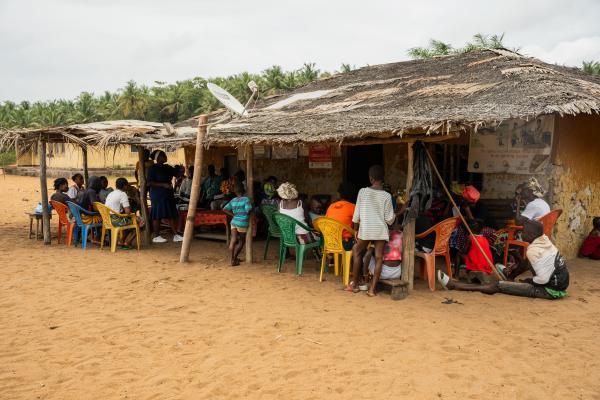
Myths surrounding contraceptives and family planning continue to pose a significant barrier to adolescents and residents in rural Liberia, especially in Maryland County, where Partners In Health Liberia operates. One common myth is the belief that adolescents who use contraceptives will be unable to bear children later on. Additionally, some people believe that healthcare workers promote contraceptive use solely to prevent adolescents from having children, rather than to help them plan, space, and take control of their reproductive lives.
Through ongoing outreach and public awareness activities in Maryland County’s urban and rural communities, this dynamic is beginning to change. Outreach teams are replacing myths with facts, empowering adolescents to make informed decisions about their sexual and reproductive health.
The World Bank reported in 2023 that 126 out of every 1,000 girls aged 15-19 in Liberia gave birth, reflecting a high teenage pregnancy rate, though it has declined since 2010. In Maryland County, Liberia, approximately one in three girls aged 15-19 is either a mother or pregnant.
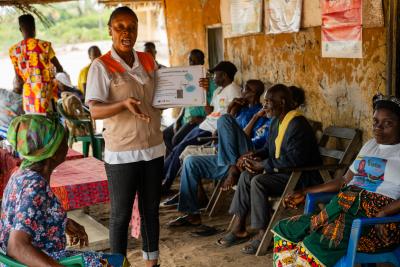
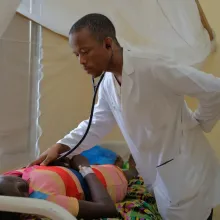
ASRH Officer Jestina D. Wesseh, along with PIH-Liberia’s Adolescent Sexual and Reproductive Health(ASRH) team, provides comprehensive information, services, and rights awareness during community outreach in Harper, Maryland County. Photo by Ansumana O. Sesay / PIH
Eighteen-year-old Martha (a pseudonym) is one of many adolescents who struggled with these myths. During an outreach activity led by Lucy Jayfin, a Community Health Promoter (CHP), Martha’s perspective on family planning changed. “During the session, I was eager to learn more about family planning, especially during the question-and-answer time,” Martha said.
The session reshaped Martha’s views. She was then referred to the nearest Partners In Health-supported Youth-Friendly Center (YFC) in her community, where she received additional counseling. After a session with Service Provider Winston Karpeh, Martha decided to get the Jadelle implant, which provides contraception for five years.
“Since January 2023, I have been using it, and it has allowed me to continue my education. I am now in the 10th grade,” Martha shared.
Teenage mothers often face adverse pregnancy outcomes and stunted educational opportunities compared to young women who delay childbearing, as highlighted in the 2019 Liberia Demographic and Health Survey (LDHS).
Partners In Health Liberia (PIHL) is continuously strengthening its collaboration with the County Health Team (CHT) and key stakeholders, including local education authorities, community leaders, schools, and non-governmental organizations, with support from the United Nations Population Fund (UNFPA), to address teenage pregnancy in Maryland County.
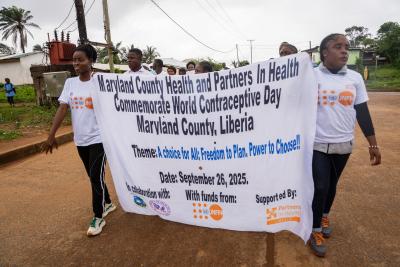
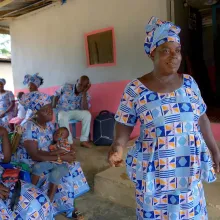
Service providers from the youth friendly center hold banner during the 2025 celebration of the World Contraception Day on September 26, 2025 in Harper City, Maryland County. Photo by Ansumana O. Sesay / PIH
Their efforts also include improving access to reproductive health education and services through a three-point model for sexual and reproductive health and rights service delivery at the YFCs. This model emphasizes education, accessibility, and empowerment, ensuring that young people receive accurate information, have access to resources, and feel confident in making informed decisions about their reproductive health. “I want to thank PIH, UNFPA, and the Maryland County Health Team for their support for adolescents in Maryland County,” Martha said.
The change in Martha’s perspective on family planning is a testament to how robust public engagement is crucial to debunking misinformation and empowering communities to make informed decisions for improved health outcomes.