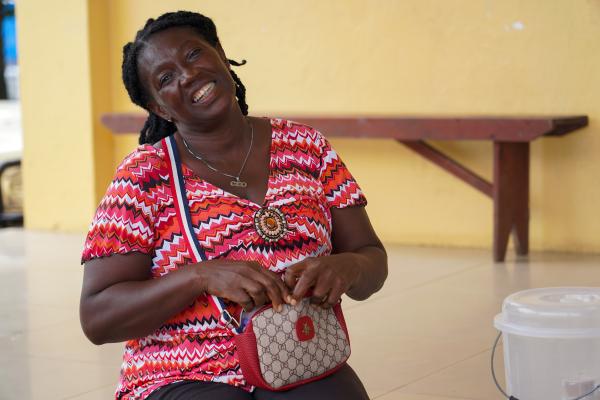
When Hawa Sheriff began to feel sick in 2019, she thought it was just a common cold. She tried some self-prescribed medications, but the symptoms would not go away. As her cough worsened, she began to worry. She sought medical care at some local hospitals, some of them twice, and was told she was negative for tuberculosis (TB). Still, her cough persisted, and the whispers and bad jokes from her fiancé and the community weighed on her. As her condition worsened, her fiancé walked away. But she encouraged herself that she would get to the root of the cough.
Determined to find answers, Hawa decided to visit the national TB Annex Hospital in Monrovia. This time, a new test came back positive for multidrug-resistant tuberculosis (MDR-TB), a more complex form of the disease. “I felt shocked,” Hawa recalled. “I never expected myself to have contacted [contracted] such sickness.”
Road to Recovery and Overcoming Stigma
Liberia records a TB incidence rate of 308 cases per 100,000 population, placing it among the top 30 highest-burdened countries for TB and TB/HIV. Despite advancements in TB diagnostics and treatment in the country, there remain persistent challenges such as stigma, misinformation, and inadequate funding.
Hawa’s diagnosis marked the beginning of a long, hopeful journey. The nurses at the TB Annex told her she would need to take medication for 20 months. “I told myself that I would still be healed,” she said.
“This is the last bus stop for TB. I believe they will help me solve my problem.”
The treatment was physically and emotionally challenging. The medication caused pain, and Hawa’s family and community abandoned her because of the fear of contracting TB as well. “PIH was my parent, they were my friends, they were doctors, and the nurses that took care of me.”
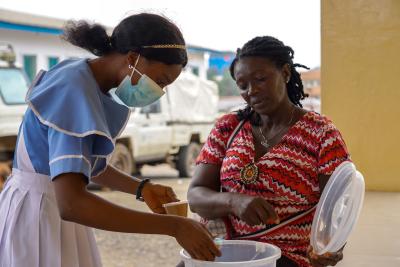
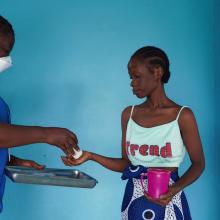
Hawa Sheriff sells convenience food, locally known as kanyan, at the TB Annex. Julies F. Yeasahn, a nursing student on clinical training at TB Annex in Monrovia, buys some of the food. Photo by Ansumana O. Sesay / PIH
Thanks to the support she received from Partners In Health (PIH) and the TB Annex Hospital nurses, Hawa never gave up. She received food, medication, and transportation to her medical appointments. The compassionate care and encouragement from the PIH team gave Hawa the strength to continue, even when those around her were unable to.
Perseverance After Treatment
Now, Hawa has completed her treatment and is back to her normal life. “I thank God that I have completed this TB treatment,” she said. “It plays a good role in my life by making me feel good.”
She is now able to care for her children, run her small business, and live a whole and healthy life. Hawa’s fiancé left her when she was sick, but she is now a proud single mother, making a life for herself and her children. “I am so proud of my healing, and I am proud of PIH,” she said.
Hawa has a message for people who find themselves in a similar situation.
“Don’t be scared,” she encouraged. “No one buys sickness, and you wouldn’t know how it may have happened. Come [to the TB Annex] and get your healing”